Ferrari
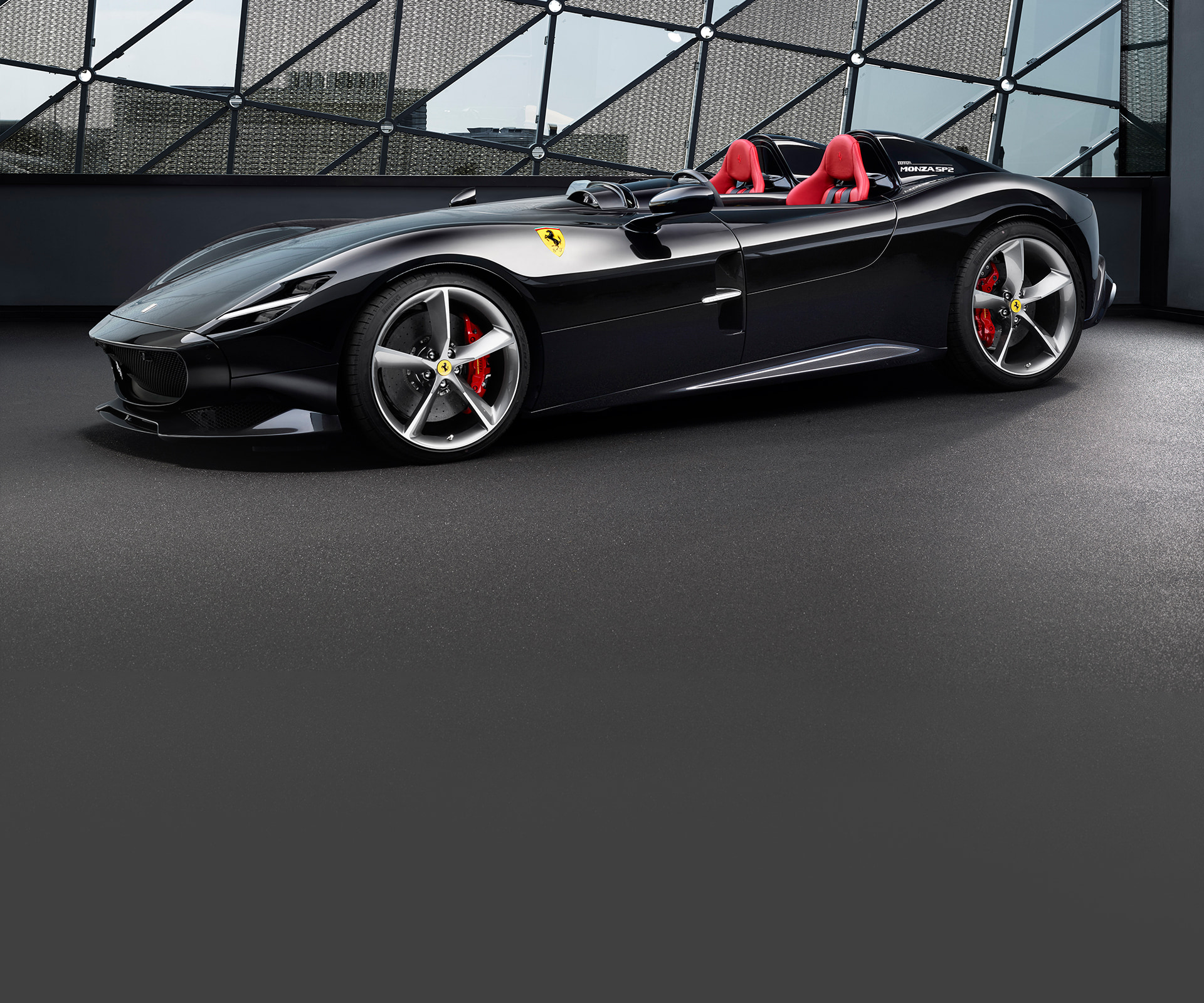
Monza SP2
Evidence
No saved capture linked
Localization
Published for this locale
Price status
Request price
Official specifications
27 official facts published for this model.
| Specification | Published value |
|---|---|
| Type | V12 – 65° |
| Overall displacement | 6496 cc |
| Bore and stroke | 94 x 78 mm |
| Max. power output* | 596 kW (810 cv) at 8500 rpm |
| Max. torque* | 719 Nm at 7000 rpm |
| Specific power output | 125 cv/l |
| Max. engine speed | 8900 rpm |
| Compression ratio | 13.6:1 |
| Length | 4657 mm |
| Width | 1996 mm |
| Height | 1155 mm |
| Wheelbase | 2720 mm |
| Front track | 1688 mm |
| Rear track | 1678 mm |
| Dry weight ** | approx. 1520 kg |
| Fuel tank capacity | 90 l |
| Front | 275/30 ZR 21 10 J |
| Rear | 315/30 ZR 20 11.5J |
| 0-100 km/h | 2.9 sec |
| 0-200 km/h | 7.9 sec |
| 100-0 km/h | 32 m |
| Maximum speed | >300 km/h |
| Low | 578 g/km |
| Mid | 354 g/km |
| High | 313 g/km |
| Extra High | 340 g/km |
| Combined | 366 g/km |
Verified trim lens
Choose the exact trim
Overview
The development of the design of the interior focused specifically on the driver cockpit.
Highlights, safety and technology
THE FIRST IN A NEW CONCEPT OF LIMITED SERIES 'ICONA' CARS
The Ferrari Monza SP2, together with the Monza SP1, are the forerunners in a new concept, known as ‘Icona’ (Icon), that taps into a leitmotif of the most evocative cars in the company’s history to create a new segment of special limited series cars for clients and collectors. The intention is to use a modern aesthetic to reinterpret a timeless style, with technologically advanced components and the highest performance possible through continuous innovation.
ELEGANCE AND REFINEMENT, IN A PENCIL STROKE
The exterior is completed by wonderfully sculptural 21” five-spoke wheels that were designed specifically to compliment the minimalist lines of the two cars.
A MODEL WHOSE CONTOURS APPEAR CRAFTED BY THE WIND
A car that seems sculpted by the wind. It is the purity of the styling elements that impresses – an aesthetic that is futuristic but, at the same time, a respectful yet un-nostalgic homage to the past.
RACING SPIRIT, ABSOLUTE COMFORT
The development of the design of the interior focused specifically on the driver cockpit.
THE MOST POWERFUL V12 EVER TO LEAVE THE GATES OF MARANELLO
Amongst these is a 350 bar direct injection system for the very first time on a high-performance petrol engine paired with variable geometry intake tracts conceptually derived from those of naturally-aspirated F1 engines.
FORMULA 1 EXCITEMENT FOR AN UNPARALLELED DRIVING EXPERIENCE
The Virtual Wind Shield is essentially an aerodynamic passage underneath the driver’s side aero screen, where the upper part is shaped as an aerofoil. Part of the air flowing over the bonnet enters the air intake under the aero screen, where it is accelerated and deflected vertically ahead of the instrument panel. This generates what is known as a highly energised upwash that deflects the flow over the driver’s head creating a low-speed bubble around the cockpit.
MAXIMUM COMFORT WITH THE VIRTUAL WIND SHIELD
The Virtual Wind Shield was patented for this car in response to the need to allow the driver enjoy it at high speeds. Although it remains below the driver’s cone of vision, it delivers maximum driving comfort for a barchetta.
BALANCED AND ENGAGING
BALANCED AND ENGAGING
UNIQUE VEHICLE DYNAMICS
The result is that the model is perfectly balanced with no roll whatsoever for almost unimaginably pure, uncompromising sports-car handling. Because there are no windscreen pillars, the driver’s view is completely unhindered and this enables them to attack corners with a freedom only experience with a Formula 1 car. The driver can thus enjoy involving and rewarding sports car responses over twisty routes: the car is always gratifying but never difficult to control.
THE UNFORGETTABLE: DISCOVER THE HISTORY OF THE RACING "BARCHETTA"
The Ferrari 166 MM “barchetta” was the cornerstone of a long line of open sports racing cars that came out of the Maranello factory through the fifties and into the early sixties. It was first presented in September 1948 at the Turin Motor Show as a “spider da corsa”.